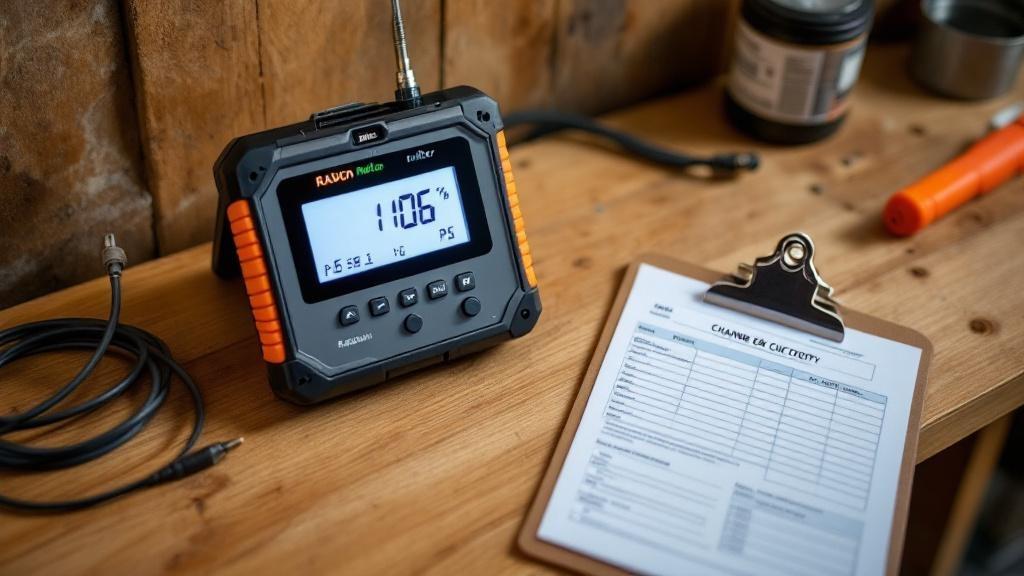
What this service covers
Testing for purchases, sales, post-mitigation verification, and plain peace of mind. Pennsylvania has certified radon testers through the DEP since 1988, and every professional report you receive here carries the tester's certification number as state law requires, along with device locations, start and stop times, and the result in pCi/L.
Typical pricing
$150-$300
Pricing varies by job specifics. Free phone or on-site quotes; fixed pricing once the technician has assessed the job.
Choosing between a 48-hour answer and a year-round answer
Short-term tests run from two days to around 90 and answer the question quickly, which is why they anchor real estate deadlines and first screenings. Charcoal canisters, electret chambers, and continuous monitors all serve here; a continuous monitor adds hourly readings that show whether a result was steady or spiked with a passing storm front. Long-term tests run beyond 90 days, usually on alpha-track detectors, and come closest to the annual average that the EPA's risk figures actually describe.
The choice usually makes itself. A purchase contract has room for a 48-hour monitor placement and nothing longer. A homeowner staring at a borderline first result, especially one taken in summer, has time to let an alpha-track detector ride through a full Pittsburgh heating season and report the number that matters. Our side-by-side comparison lays out cost, timing, and what each can and cannot tell you.
Professional short-term testing runs $150 to $300 here. A hardware-store charcoal kit costs $15 to $30 and gives a legitimate screening number when its instructions are followed, though a transaction needs a certified tester. Pennsylvania certifies testers through the DEP and lists them in its Radon Services Directory, and the certification number belongs on every professional report.
Placement and closed-house conditions in a hillside city
A radon number is a measurement of the house under specific conditions, so the conditions are part of the result. Short tests need closed-house conditions beginning 12 hours before the start: windows shut, exterior doors used only for coming and going, heating running normally. The device belongs in the lowest level anyone regularly uses, out of kitchens, bathrooms, and laundry rooms, away from exterior walls, drafts, heat sources, and sump pits.
Pittsburgh adds a wrinkle the people who drafted testing protocols never had to picture: which level is "lowest" in a house built into a hill? A walkout lower level with a sliding door to the backyard still counts if people live in it, and it usually reads differently from a fully buried basement because only part of it touches soil. In a three-story house with a basement nobody enters, the test still starts there if the space could be lived in, because that is the number a future finished-basement decision needs.
In a sale, the details tighten: the test anchors to the inspection window, the devices sit side by side or a continuous monitor runs at least 48 hours, and everyone in the house agrees not to open the place up mid-test. Tampering shows up in the data more often than people expect, and a voided test helps nobody's deadline. See testing before buying for the transaction sequence.
Reading your result like the EPA does
The EPA's action level is 4.0 pCi/L: at or above it, fix the home. Between 2 and 4, the EPA recommends considering a fix, because no level is risk-free and the risk scales with concentration and years. Below 2, retest every couple of years and after any renovation that touches the foundation, the HVAC, or how you use the lowest level.
Context helps a Pittsburgh reader more than most. About 40 percent of Pennsylvania homes tested are at or above 4 pCi/L according to the PA DEP, a USGS analysis of 1990 to 2007 state data put the share at 39 percent, and an AARST summary of 940,627 results reported to the DEP from 2010 to 2020 put it at 35 percent. Those three numbers from three windows tell one story: an elevated result in this region is ordinary, not alarming, and it has a routine engineering fix.
One result is a data point, not a verdict. Radon varies by season and weather, so a borderline short-term number earns a second test, long-term if the calendar allows, before anyone spends mitigation money. And a high first number is not an emergency measured in days; it is a strong reason to schedule the fix this season. Start with what your result means or the cost calculator.
Service area
Radon Testing is available across Greater Pittsburgh and Western Pennsylvania. Per-suburb pages: