What this service covers
Active soil depressurization built around the foundation in front of you: a hand-laid stone basement from the 1920s, a block-wall walkout cut into a hillside, a coal cellar turned laundry room, or a poured basement in a newer Cranberry plan. Every install is performed by a Pennsylvania DEP-certified mitigation professional working to the ANSI/AARST SGM-SF-2023 standard, and the post-install verification report carries the certification number Pennsylvania has required on radon reports since 1988.
Typical pricing
$1,100-$2,600
Pricing varies by job specifics. Free phone or on-site quotes; fixed pricing once the technician has assessed the job.
What an active system does under a Pittsburgh foundation
Soil gas moves toward low pressure, and in a heated Western Pennsylvania house the lowest pressure in the neighborhood is usually your basement. A mitigation system reverses that. A suction cavity is opened beneath the slab or beneath a sealed crawl-space membrane, piping carries the gas up past the roof, and an inline fan keeps the soil side of the foundation at lower pressure than the rooms above it around the clock. The EPA's consumer guidance rates active sub-slab suction as the most reliable fix, reducing indoor levels by anywhere from half to over 99 percent depending on the house.
Pittsburgh houses complicate the picture in ways a flat Midwestern subdivision never does. A stone foundation offers hundreds of mortar joints instead of four clean walls. A floor poured in the 1930s and patched in every decade since behaves like several small slabs rather than one, and suction that reaches the front of the basement may never reach the back. A hillside walkout buries one wall and exposes the other, which shifts where gas enters and where a suction point belongs. The pre-install diagnostics, a visual survey plus a communication test where the sub-slab material is unknown, are what turn those quirks into a design instead of a surprise.
Sealing comes with every install but never replaces the fan. Slab cracks, the floor-wall joint, plumbing cuts, and an old coal-chute opening get closed so the fan draws from the soil rather than from the room. Our pricing guide by foundation type shows how each of these findings moves the number.
Certification is the law, and the paperwork proves it
Pennsylvania took radon seriously earlier than almost any state. The Radon Certification Act has required Department of Environmental Protection certification for radon testing, mitigation, and laboratory analysis since September 1988, with the program's rules codified in Chapter 240 of Title 25 of the Pennsylvania Code. Anyone you pay to test or fix your house must hold the matching DEP certification, and the certification number must appear on every report you receive. The DEP also publishes a Radon Services Directory, so a certification claim takes about a minute to verify from your kitchen table.
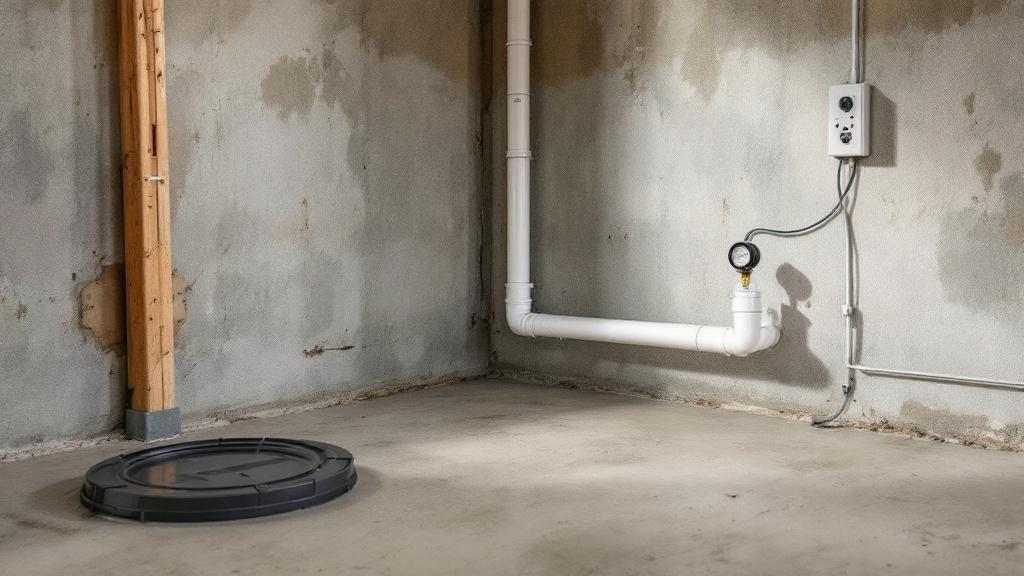
All mitigation professionals you work with here hold current PA DEP mitigation certification and carry insurance, and installs follow ANSI/AARST SGM-SF-2023, the national soil gas mitigation standard for homes. In practice that standard shapes the details a homeowner can see: the fan mounted outside the living space, the discharge terminating above the roof and away from windows, a pressure gauge on the pipe so you can confirm the system is pulling, and labels identifying the system and its circuit.
The last step is the one that makes the rest honest: a post-mitigation test, documented in writing with the certification number on the report, confirming where the house landed. Keep that report with your house records; the next buyer's agent will ask for it. See how to check a Pennsylvania certification for the lookup steps.
Why this region's housing makes design the whole job
Two facts set Pittsburgh apart. First, the geology: the region sits on the uranium-bearing Pennsylvanian-age cyclic shales and limestones of the Appalachian Plateau, the rock sequence the USGS flags in its geologic radon assessment of the state, and the measured results match it. The PA DEP reports that about 40 percent of Pennsylvania homes tested are at or above the EPA action level of 4 pCi/L. Second, the housing: roughly 70 percent of the region's homes predate 1980, the oldest stock of any metro this size, and old houses offer soil gas more doors than new ones.
The doors have names here. Stone foundations from the 1900s through the 1940s, with mortar joints that have been weeping air for a century. Coal cellars under front porches, converted to storage or laundry rooms with the chute wall never sealed. French drains and open perimeter channels cut along slab edges to manage hillside water, which double as a continuous soil-gas slot around the basement. Three-story frame houses whose winter stack effect pulls on the basement like a chimney.
None of that makes a house unfixable. It makes the diagnostic visit the most valuable hour of the project, because the difference between a system that verifies below 2 pCi/L and one that disappoints is almost always a missed entry path or an undersized pressure field, decided before any pipe was cut. Read how designs change on stone foundations and hillside walkouts.
Service area
Radon Mitigation Systems is available across Greater Pittsburgh and Western Pennsylvania. Per-suburb pages: